
How to Become a Generative AI Expert and Get a Job in 2026
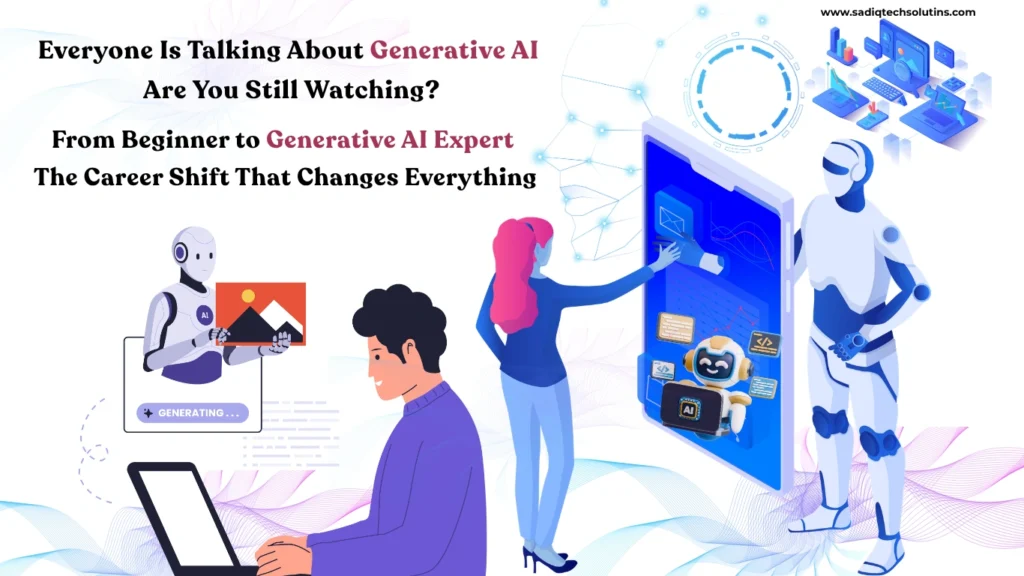
Generative AI Expert is no longer a buzzword reserved for researchers and Silicon Valley insiders. It has become one of the most sought-after skill sets in the global job market. Companies across industries from healthcare and finance to marketing and education are actively hiring professionals who understand and can work with generative ai technologies. If you are wondering how to position yourself for one of these high-paying, future-proof careers, this comprehensive guide is exactly what you need.
In this article, you will learn everything from foundational concepts to advanced skills, from the best certifications to real-world project strategies all designed to help you become a credible generative ai expert and stand out to employers.
What Is Generative AI and Why Is It a Career Game-Changer?
Generative AI Expert refers to a class of artificial intelligence models capable of creating new content text, images, audio, video, code, and more by learning patterns from large datasets. Unlike traditional AI systems that classify or predict based on existing data, generative ai systems produce original outputs that are statistically coherent and contextually relevant.
Key technologies powering generative AI include:
- Large Language Models (LLMs) such as GPT-4, Claude, and Gemini for text generation
- Diffusion Models like Stable Diffusion and DALL-E for image synthesis
- Generative Adversarial Networks (GANs) for realistic data generation
- Variational Autoencoders (VAEs) for structured latent space generation
- Multimodal Models that combine vision, language, and audio understanding
According to multiple industry reports, demand for generative ai professionals has surged by over 300% since 2023. Job roles range from Prompt Engineer and AI Product Manager to ML Research Scientist and LLM Application Developer all commanding salaries well above industry averages.
Step-by-Step Roadmap to Become a Generative AI Expert
Becoming a generative ai expert is a structured journey. Here is a practical, step-by-step roadmap that takes you from beginner to job-ready professional.
Step 1: Build a Strong Foundation in Mathematics and Programming
Every generative ai expert begins with a solid grounding in the fundamentals. You do not need a PhD, but you do need to be comfortable with the following:
- Linear Algebra: vectors, matrices, dot products, eigenvalues the language of neural networks
- Calculus: derivatives, gradients, and backpropagation how models learn
- Probability and Statistics: distributions, Bayesian thinking, and uncertainty
- Python Programming: the primary language for AI/ML development
- Libraries: NumPy, Pandas, Matplotlib for data handling and visualization
Resources like Khan Academy, 3Blue1Brown’s Essence of Linear Algebra, and fast.ai’s Practical Deep Learning for Coders are excellent starting points that are completely free.
Step 2: Master Machine Learning and Deep Learning Concepts
Generative AI Expert is built on deep learning. Before diving into LLMs and diffusion models, you need a solid understanding of how neural networks function at their core. Study the following topics:
- Supervised and unsupervised learning paradigms
- Convolutional Neural Networks (CNNs) for image processing
- Recurrent Neural Networks (RNNs) and LSTMs for sequential data
- The Transformer architecture the backbone of modern generative ai
- Attention mechanisms and self-attention
- Training techniques: batch normalization, dropout, learning rate scheduling
The foundational paper “Attention Is All You Need” by Vaswani et al. (2017) is required reading for anyone serious about generative ai. It introduced the Transformer model that underlies GPT, BERT, T5, and virtually every major LLM today.
Step 3: Learn the Core Generative AI Frameworks and Tools
To become a generative ai expert, you must become proficient with the industry-standard tools and frameworks. Here is what employers expect you to know:
- Hugging Face Transformers: the go-to library for loading, fine-tuning, and deploying LLMs
- LangChain and LlamaIndex: frameworks for building LLM-powered applications
- OpenAI API: for integrating GPT models into applications
- PyTorch and TensorFlow: core deep learning frameworks
- Stable Diffusion / SDXL: for image generation projects
- Vector Databases (Pinecone, Weaviate, ChromaDB): for Retrieval-Augmented Generation (RAG)
- PEFT and LoRA: parameter-efficient fine-tuning techniques for LLMs
Prompt Engineering: A Critical Skill for Generative AI Experts
Prompt engineering is the art and science of crafting inputs that guide generative ai Expert models to produce desired outputs. It has emerged as a standalone, highly valued skill that does not necessarily require deep programming expertise making it an excellent entry point for career switchers.
Key prompt engineering techniques to master include:
- Zero-shot and few-shot prompting for immediate task performance without training
- Chain-of-Thought (CoT) prompting to improve reasoning in complex tasks
- ReAct (Reasoning + Acting) prompting for agentic workflows
- System prompts and persona engineering for consistent AI behavior
- Output formatting control using structured JSON and XML schemas
- Iterative prompt refinement and A/B testing for production applications
Many companies now hire dedicated Prompt Engineers with salaries ranging from $90,000 to $175,000 per year. Even if your primary role is not prompt engineering, demonstrating proficiency in this area dramatically increases your value as a generative ai professional.
Fine-Tuning and RAG: Advanced Generative AI Skills Employers Want
Moving beyond using pre-trained models, generative ai experts are expected to customize and optimize models for specific business use cases. Two techniques dominate this space:
Fine-Tuning Large Language Models
Fine-tuning involves training a pre-trained model on domain-specific data so it performs better for targeted applications. Modern approaches include:
- Full fine-tuning (resource-intensive, maximum customization)
- LoRA (Low-Rank Adaptation) fine-tune with a fraction of GPU memory
- QLoRA quantized fine-tuning for consumer hardware
- Instruction tuning to align models with specific task formats
- RLHF (Reinforcement Learning from Human Feedback) for preference alignment
Retrieval-Augmented Generation (RAG)
RAG is one of the most practical and widely-deployed techniques in generative ai enterprise applications. It combines the power of LLMs with external knowledge retrieval, allowing models to answer questions about proprietary or up-to-date information without full retraining. Core components include:
- Document chunking and embedding strategies for optimal retrieval
- Vector similarity search using cosine distance or approximate nearest neighbors
- Re-ranking retrieved documents for relevance before generation
- Hybrid search combining keyword (BM25) and semantic (vector) retrieval
- Evaluation metrics: faithfulness, answer relevancy, and context precision
Best Certifications to Validate Your Generative AI Expertise
Certifications signal to employers that you have invested time in structured learning and have verified competence. Here are the most respected credentials in the generative ai space:
| Certification | Provider | Best For |
| Generative AI with LLMs | DeepLearning.AI / AWS | Beginners to Intermediate |
| Professional ML Engineer | Google Cloud | Production ML deployment |
| AWS Certified ML Specialty | Amazon Web Services | Cloud-based AI solutions |
| TensorFlow Developer Certificate | Google / TensorFlow | Model building & training |
| Hugging Face NLP Course | Hugging Face | LLMs & Transformers practitioners |
| Microsoft Azure AI Engineer | Microsoft | Enterprise AI integration |
Build a Generative AI Expert Portfolio That Gets You Hired
Hiring managers want to see evidence of your generative ai skills, not just a list of courses. A strong portfolio is often the deciding factor between two equally-qualified candidates. Here are high-impact project ideas that demonstrate real competence:
- RAG-powered document Q&A chatbot using LangChain, ChromaDB, and an open-source LLM
- Fine-tuned customer support agent using QLoRA on a domain-specific dataset
- Text-to-image generation pipeline with prompt optimization and style control
- AI code review assistant that integrates with GitHub via the OpenAI API
- Multimodal product description generator combining vision and language models
- LLM evaluation harness comparing GPT-4, Claude, and Gemini on custom benchmarks
Host all projects on GitHub with detailed README files, architecture diagrams, and demo videos. Deploy at least two projects as live web applications using Gradio, Streamlit, or Hugging Face Spaces. Employers are far more impressed by a working URL than a code repository alone.
Generative AI Job Roles and Career Paths in 2025
The generative ai Expert job market has expanded significantly, creating diverse career paths suited to different backgrounds and interests. Understanding the landscape helps you target your skill development more effectively.
- AI/ML Engineer: Builds, trains, and deploys generative ai models in production; requires strong Python and deep learning skills
- LLM Application Developer: Develops applications powered by large language models using APIs, LangChain, and RAG pipelines
- Prompt Engineer: Designs, tests, and optimizes prompts for consistent and high-quality AI outputs across use cases
- AI Product Manager: Bridges business needs and AI capabilities; defines product vision for generative ai features
- AI Research Scientist: Conducts original research on generative ai architectures, training methods, and evaluation
- MLOps Engineer: Manages the infrastructure for training, deploying, monitoring, and scaling AI models
Networking, Community, and Personal Branding for Generative AI Professionals
Technical skills alone are rarely enough to land a job in generative ai. Building a visible professional presence accelerates your career trajectory enormously. Here is how to do it effectively:
- Write on LinkedIn about your generative ai Expert learning journey — even weekly updates build visibility and attract recruiters
- Contribute to open-source projects on Hugging Face Hub or GitHub to demonstrate collaborative skills
- Participate in AI competitions on Kaggle, specifically targeting NLP and generative ai tracks
- Attend virtual and in-person AI conferences such as NeurIPS, ICML, and regional AI meetups
- Join communities like the Hugging Face Discord, Reddit’s r/MachineLearning, and AI-specific Slack groups
- Publish technical blog posts or YouTube tutorials explaining generative ai concepts teaching is the fastest way to deepen expertise
Recruiters at top AI companies actively scout LinkedIn for candidates who are sharing original generative ai content. A consistent posting habit of just two to three times per week can put you on their radar within a few months.
Common Mistakes to Avoid on Your Generative AI Learning Journey
- Tutorial paralysis: watching courses without building real projects delays your progress significantly
- Skipping fundamentals: jumping straight to advanced LLM topics without understanding backpropagation creates fragile knowledge
- Ignoring evaluation: generative ai without robust evaluation metrics produces unreliable systems that fail in production
- Neglecting MLOps: knowing how to train a model but not deploy or monitor it is a critical gap employers notice
- Overlooking ethics: responsible AI, bias detection, and safety considerations are increasingly weighted in hiring decisions
Realistic Timeline to Become a Job-Ready Generative AI Expert
The time required depends on your starting point, but here is a realistic general timeline for someone with basic programming knowledge:
- Months 1-2: Python proficiency, mathematics review, and introduction to machine learning concepts
- Months 3-4: Deep learning fundamentals, Transformer architecture, and first Hugging Face projects
- Months 5-6: LLM application development with LangChain, RAG implementation, and portfolio projects
- Months 7-8: Fine-tuning experiments, MLOps basics, and advanced prompt engineering
- Months 9-10: Job applications, technical interview preparation, and networking intensification
Many people break into the generative ai field in 6 to 12 months of dedicated, focused learning. The key is consistency even one to two focused hours per day will produce remarkable progress over a year.
Conclusion: Your Generative AI Career Starts Today
The window of opportunity to enter the generative ai field is wide open right now. Companies are struggling to find qualified professionals, salaries are at historic highs, and the technologies are accessible enough that anyone with dedication can build real expertise. Whether you are a software developer looking to specialize, a data analyst ready to upskill, or a complete beginner willing to commit to the learning process, the path to becoming a generative ai expert is clearly mapped out.
Start with the foundations, build relentlessly, showcase your work publicly, and connect with the global generative ai community. The job offers will follow.
Frequently Asked Questions (FAQs)
Do I need a degree to become a generative ai expert?
No. While a degree in computer science or mathematics is helpful, most generative ai professionals today are self-taught or have completed online courses and bootcamps. What matters to employers is your portfolio, practical skills, and ability to solve real problems with AI.
How much does a generative ai expert earn?
Salaries vary by role and location, but generative ai professionals typically earn between $120,000 and $250,000 per year in the United States. Roles like AI Research Scientist at top labs can exceed $400,000 in total compensation including equity.
What programming language is most important for generative ai?
Python is overwhelmingly the most important language in the generative ai ecosystem. Nearly all major frameworks including PyTorch, TensorFlow, Hugging Face Transformers, and LangChain are Python-first. Strong Python skills are non-negotiable.
Is prompt engineering a real career?
Yes. Prompt engineering has become a well-recognized and well-compensated role, particularly in companies deploying LLM-powered products at scale. However, the best prompt engineers also understand the underlying generative ai Expert models they are working with.
What is the most important generative ai Expert skill for getting a job?
Building and deploying end-to-end generative ai applications particularly RAG systems and fine-tuned LLMs is currently the most valued practical skill. Pair this with strong communication skills and a visible portfolio, and you are extremely well-positioned.
Ready to Start Your IT Career Journey?
Enroll for IT Career Courses Coding & Non-coding & Internship Program Today
→ https://sadiqtechsolutions.com/
For IT Career Courses Coding & Non-coding & e-Books this is the best site
→ https://topitcourses.com/
If you need IT Resume Templates for Free then Download Free Resumes here
→ https://topitcourses.com/free-resumes-download/
Read More Related Posts
Data Analyst vs Data Scientist: Key Differences Explained
→ https://topitcourses.com/data-analyst-vs-data-scientist-key-differences/
Edge AI vs Cloud AI: Which Should Your Business Use in 2026?
→ https://topitcourses.com/edge-ai-vs-cloud-ai-2026/
AI Impact on IT Jobs
→https://sadiqtechsolutions.com/ai-impact-on-it-jobs/
AI Automation Engineer Skills Required & Roadmap
→ https://sadiqtechsolutions.com/ai-automation-engineer-skills/
What is a Sailpoint Developer?
→https://topitcourses.com/what-is-sailpoint-developer-complete-guide/
Java Full Stack Developer Career Guide 2026
→ https://sadiqtechsolutions.com/java-full-stack-developer-career-guide-2026-salary-skills/
How to become a Prompt Engineer in 2026
→ https://sadiqtechsolutions.com/prompt-engineering-in-2026-skills-career-guide/
Thankyou