
Why Python Is the Most Popular Programming Language : A 12 Steps Complete Guide
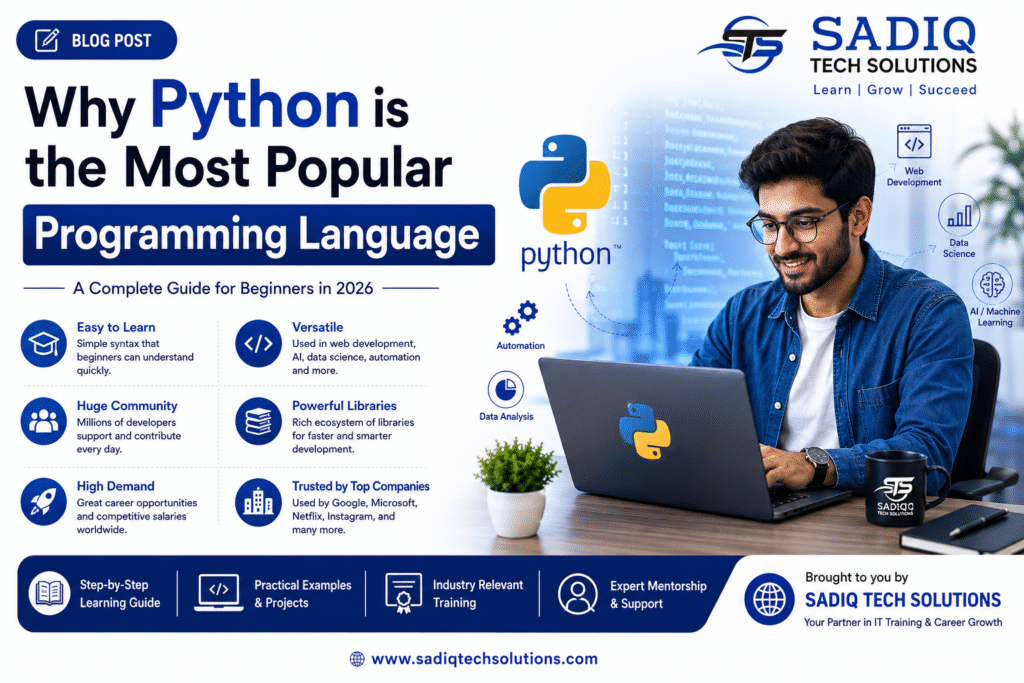
Why Python Became the Most Popular Programming Language
Several factors have contributed to Python’s widespread popularity.
Easy to Learn
It has a simple and readable syntax, making it ideal for beginners.
Huge Community Support
Millions of developers actively contribute tutorials, libraries, forums, and open-source projects.
Powerful Libraries
It offers thousands of libraries that reduce development time.
Examples include:
- NumPy
- Pandas
- TensorFlow
- Scikit-learn
- Flask
- Django
- Matplotlib
- Requests
Cross-Platform Compatibility
Python works on:
- Windows
- Linux
- macOS
Excellent Career Opportunities
Companies worldwide actively hire Python developers across various industries.
A Complete Step-by-Step Guide
In today’s technology-driven world, Python has become the most preferred Programming Language for beginners, students, software developers, data scientists, cybersecurity professionals, and artificial intelligence engineers. From startups to global technology companies like Google, Microsoft, Amazon, Netflix, Meta, and NASA, Python is widely used to build powerful applications and automate complex tasks.
Its simple syntax, readability, extensive libraries, and versatility have made Python the first choice for millions of developers worldwide. Whether you want to become a software developer, web developer, AI engineer, machine learning expert, data analyst, automation engineer, or cybersecurity professional, learning Python is an excellent investment in your future.
This comprehensive guide explains step by step why Python is the world’s most popular Programming Language, what makes it unique, how to learn it, career opportunities, salary expectations, and practical tips for mastering in 2026.
What Is Python?
It is a high-level, interpreted, general-purpose Programming Language created by Guido van Rossum and first released in 1991.
It is designed to emphasize readability and simplicity, allowing developers to write fewer lines of code while accomplishing more tasks.
It is used for:
- Web Development
- Artificial Intelligence
- Machine Learning
- Data Science
- Automation
- Cybersecurity
- Cloud Computing
- Internet of Things (IoT)
- Desktop Applications
- Game Development
- Scientific Computing
Its flexibility allows developers to use Python for almost every area of software development.
Step 1: Understand Python Basics
Before writing code, understand the fundamentals.
Learn about:
- Python installation
- Python interpreter
- IDEs
- Running Python programs
- Comments
- Indentation
- Basic syntax
Popular IDEs include:
- Visual Studio Code
- PyCharm
- Jupyter Notebook
- Spyder
Understanding these basics builds a strong foundation.
Step 2: Learn Python Syntax
Syntax is one of the simplest among programming languages.
Topics include:
- Print statements
- Comments
- Indentation
- Input and output
- Code formatting
Because Python uses indentation instead of braces, programs are easier to read and maintain.
Step 3: Master Variables and Data Types
Variables store information.
Learn the major data types:
- Integer
- Float
- String
- Boolean
- List
- Tuple
- Dictionary
- Set
Understanding data types helps you build efficient programs.
Step 4: Learn Operators
Operators perform calculations and comparisons.
Study:
- Arithmetic operators
- Assignment operators
- Comparison operators
- Logical operators
- Bitwise operators
- Membership operators
- Identity operators
Operators are essential for writing logical programs.
Step 5: Understand Conditional Statements
Programs make decisions using conditions.
Learn:
- if
- else
- elif
- Nested conditions
Conditional statements control program flow based on user input or business logic.
Step 6: Learn Loops
Loops automate repetitive tasks.
Master:
- for loop
- while loop
- break
- continue
- pass
Loops are commonly used in automation, data processing, and application development.
Step 7: Work with Functions
Functions organize reusable code.
Topics include:
- Function definition
- Parameters
- Arguments
- Return values
- Lambda functions
- Recursive functions
Functions improve code readability and maintainability.
Step 8: Master Python Data Structures
Data structures organize information efficiently.
Learn:
Lists
Store ordered collections.
Tuples
Store immutable data.
Dictionaries
Store key-value pairs.
Sets
Store unique values.
Choosing the right data structure improves application performance.
Step 9: Learn Object-Oriented Programming (OOP)
OOP helps build scalable applications.
Study:
- Classes
- Objects
- Constructors
- Inheritance
- Encapsulation
- Polymorphism
- Abstraction
Most enterprise applications use OOP concepts.
Step 10: Handle Files and Exceptions
Applications often interact with files.
Learn:
- Reading files
- Writing files
- CSV files
- JSON files
- Exception handling
- try
- except
- finally
Proper error handling makes applications more reliable.
Step 11: Explore Python Libraries
One reason why it is the most popular Programming Language is its rich ecosystem of libraries.
Popular libraries include:
NumPy
Numerical computing.
Pandas
Data analysis.
Matplotlib
Data visualization.
TensorFlow
Artificial Intelligence.
Scikit-learn
Machine Learning.
Django
Web development.
Flask
Lightweight web applications.
BeautifulSoup
Web scraping.
Requests
API communication.
Learning these libraries expands your development capabilities.
Step 12: Build Real-World Projects
Practical projects demonstrate your skills.
Beginner-friendly ideas:
- Calculator
- Password Generator
- To-Do List
- Expense Tracker
- Weather App
- Quiz Application
- Student Management System
- Hospital Management System
- Chat Application
- Inventory Management System
Upload projects to GitHub to showcase your portfolio.
Advantages
It offers numerous benefits.
- Easy to learn
- Readable syntax
- Open source
- Large community
- Extensive libraries
- Cross-platform
- High productivity
- Excellent documentation
- Strong integration capabilities
- Scalable for enterprise applications
These advantages contribute to its enduring popularity.
Career Opportunities After Learning Python
It opens doors to diverse roles.
Popular career paths include:
- Python Developer
- Software Engineer
- Full Stack Developer
- Data Analyst
- Data Scientist
- Machine Learning Engineer
- AI Engineer
- Automation Engineer
- Cybersecurity Analyst
- Cloud Engineer
- DevOps Engineer
- Backend Developer
Its versatility makes Python valuable across multiple domains.
Top Companies Using Python
Many leading organizations rely on Python.
Examples include:
- Microsoft
- Amazon
- Netflix
- Spotify
- Dropbox
- Uber
- NASA
Industries That Use Python
It is widely adopted in:
- Healthcare
- Finance
- Banking
- Education
- E-commerce
- Artificial Intelligence
- Cloud Computing
- Cybersecurity
- Manufacturing
- Government
- Research
- Entertainment
Its flexibility makes it suitable for virtually every industry.
Common Mistakes Beginners Make
Avoid these mistakes:
- Skipping the basics
- Memorizing code instead of understanding concepts
- Not practicing regularly
- Ignoring debugging
- Avoiding projects
- Not learning Git and GitHub
- Neglecting documentation
- Trying to learn too many frameworks at once
Consistent practice and hands-on learning are essential.
Future of Python in 2026 and Beyond
It continues to evolve with emerging technologies.
Growth areas include:
- Artificial Intelligence
- Machine Learning
- Data Science
- Automation
- Robotics
- Cloud Computing
- Cybersecurity
- Internet of Things (IoT)
- Generative AI
- Quantum Computing Research
As these fields expand, Python’s relevance is expected to grow even further.
How to Practice Python Every Day
To accelerate your learning:
- Solve coding challenges on HackerRank and LeetCode.
- Build one mini-project every month.
- Read official Python documentation.
- Contribute to open-source projects.
- Watch technical tutorials and webinars.
- Join Python communities and forums.
- Review and refactor your code regularly.
Daily practice builds confidence and proficiency.
Salary Expectations for Python Developers
Approximate annual salaries:
| Country | Salary |
|---|---|
| India | ₹4 LPA – ₹15 LPA |
| USA | $90,000 – $160,000 |
| UK | £40,000 – £80,000 |
| Canada | CAD 70,000 – CAD 120,000 |
| Australia | AUD 80,000 – AUD 140,000 |
Salaries vary based on experience, specialization, certifications, and location.
The Importance of Problem-Solving Skills
Learning any coding technology is not just about memorizing syntax. Successful developers focus on understanding how to solve real-world problems efficiently. Strong analytical thinking, logical reasoning, and debugging skills are essential for building reliable software. As you practice, you’ll become more confident in breaking complex problems into smaller, manageable tasks.
Best Practices for New Developers
Every beginner should follow coding best practices from the beginning. Writing clean, readable, and well-documented code makes projects easier to maintain and improves collaboration with other developers. Regular testing, version control with Git, and code reviews also help improve software quality and prepare learners for professional development environments.
Open-Source Contributions
Contributing to open-source projects is one of the best ways to gain practical experience. It allows learners to work with real-world applications, collaborate with experienced developers, and improve coding standards. Even small contributions, such as fixing documentation or resolving minor issues, can strengthen a portfolio and demonstrate initiative to employers.
Building a Professional Portfolio
A strong portfolio showcases practical skills better than certificates alone. Include personal projects, GitHub repositories, technical blogs, and project documentation. Explain the problem each project solves, the technologies used, and the challenges overcome during development. A well-organized portfolio can significantly improve job opportunities.
Interview Preparation Tips
Technical interviews often assess more than coding ability. Employers also evaluate communication, teamwork, and problem-solving skills. Prepare by practicing coding challenges, reviewing fundamental computer science concepts, and participating in mock interviews. Being able to explain your thought process clearly is just as important as arriving at the correct solution.
Learning Resources for Continuous Growth
Technology evolves rapidly, making continuous learning essential. Follow official documentation, attend webinars, join developer communities, and participate in coding competitions. Reading technical blogs, listening to podcasts, and experimenting with new tools will help you stay updated with industry trends and best practices.
Career Growth Opportunities
After gaining experience, professionals can move into specialized roles such as software architect, cloud engineer, DevOps engineer, data engineer, AI specialist, cybersecurity analyst, or technical consultant. Continuous learning, certifications, and hands-on experience open the door to higher-paying positions and leadership opportunities.
Why Hands-On Practice Matters
Theory provides a foundation, but practical experience develops real expertise. Working on personal projects, solving coding challenges, and building complete applications reinforce concepts and improve confidence. Employers value candidates who can demonstrate practical problem-solving abilities through real-world examples.
Soft Skills That Employers Value
Technical knowledge alone is not enough for long-term success. Employers also look for communication skills, adaptability, teamwork, time management, creativity, and a willingness to learn. Developing these skills helps professionals collaborate effectively and advance into senior roles.
How Coding Improves Logical Thinking
Learning to code strengthens logical thinking and problem-solving abilities. Developers learn how to analyze situations, identify patterns, and create efficient solutions for complex challenges. These skills are valuable not only in software development but also in business analysis, engineering, finance, healthcare, and many other industries.
Regular practice helps improve critical thinking and teaches developers to approach problems in a structured manner.
Importance of Continuous Learning in Technology
The technology industry evolves rapidly, with new tools, frameworks, and best practices emerging every year. Successful professionals dedicate time to continuous learning by reading documentation, attending webinars, completing online courses, and participating in technical communities.
Staying updated with industry trends helps professionals remain competitive and adapt to changing job requirements.
Building Strong Debugging Skills
Writing code is only part of software development. Finding and fixing errors is equally important. Debugging teaches patience, attention to detail, and systematic thinking.
Developers who understand debugging techniques can quickly identify issues, improve application performance, and deliver more reliable software.
Useful debugging practices include:
- Reading error messages carefully
- Testing one change at a time
- Using debugging tools
- Logging important information
- Writing unit tests
Why Employers Prefer Practical Experience
Recruiters often prioritize practical knowledge over theoretical understanding. Candidates who have completed real-world projects demonstrate their ability to solve business problems and work with modern development tools.
Creating applications, contributing to open-source projects, and maintaining an active GitHub profile can significantly improve employment opportunities.
The Role of Version Control in Software Development
Version control systems help teams manage code efficiently. They allow developers to track changes, collaborate with teammates, restore previous versions, and maintain project history.
Learning Git and GitHub is considered an essential skill for anyone pursuing a career in software development.
Benefits include:
Working on Team Projects
Most software is developed by teams rather than individuals. Team projects teach collaboration, communication, and project management while exposing learners to real-world development workflows.
Working with others also improves code quality through peer reviews and shared problem-solving.Importance of Documentation
Good documentation makes software easier to understand, maintain, and improve. Clear documentation helps other developers quickly learn how a project works and reduces confusion during future updates.
Professional documentation usually includes:
- Project overview
- Installation instructions
- Features
- Folder structure
- Usage examples
- Troubleshooting tips
Time Management for Beginners
Many beginners try to learn too many technologies at once, which often leads to frustration. Creating a realistic study schedule helps maintain consistency and improve long-term learning outcomes.
A productive learning routine may include:
- 1 hour of theory
- 1 hour of coding practice
- 30 minutes of problem-solving
- 30 minutes of project development
Consistency is more valuable than studying for long hours occasionally.
Benefits of Joining Developer Communities
Online communities provide valuable support, learning resources, and networking opportunities. Engaging with experienced professionals allows beginners to ask questions, receive feedback, and discover industry best practices.
Popular communities include:
- GitHub
- Stack Overflow
- Reddit programming communities
- Discord developer groups
- LinkedIn professional groups
Trends Shaping Software Development in 2026
Technology continues to evolve rapidly, creating exciting opportunities for developers.
Some major trends include:
- Artificial Intelligence integration
- Low-code and no-code platforms
- Cloud-native applications
- DevSecOps adoption
- Edge computing
- Internet of Things (IoT)
- Generative AI tools
- Blockchain applications
- Green software engineering
- Quantum computing research
Professionals who stay updated with these trends will be better prepared for future career opportunities.
How Sadiq Tech Solutions Can Help You Learn Python
If you’re looking to build a strong foundation in Python, Sadiq Tech Solutions offers industry-focused training designed for students, fresh graduates, and working professionals. The curriculum covers Its fundamentals, object-oriented programming, file handling, database connectivity, web development, automation, APIs, data analysis, and real-world projects. Learners also receive guidance on resume preparation, GitHub portfolio development, interview skills, and placement support, helping them become job-ready for careers in software development, data science, AI, and automation.
Conclusion
It has earned its position as the world’s most popular Programming Language because of its simplicity, versatility, and vast ecosystem. Whether you’re a beginner taking your first steps into coding or an experienced professional looking to expand your skills, It provides endless opportunities across web development, artificial intelligence, machine learning, data science, cybersecurity, automation, and cloud computing.
By following this step-by-step roadmap, practicing consistently, and building real-world projects, you can master Python and unlock exciting career opportunities in 2026 and beyond. Focus on understanding the fundamentals, exploring powerful libraries, and applying your knowledge through hands-on experience. With dedication and continuous learning, It can become the foundation of a successful and future-ready technology career.
Frequently Asked Questions (FAQs)
1. Why is Python the most popular Programming Language?
It is easy to learn, highly readable, versatile, and supported by a massive community with thousands of libraries for almost every application.
2. Is Python good for beginners?
Yes. Its simple syntax and extensive learning resources make it one of the best programming languages for beginners.
3. What can I build using Python?
You can build websites, automation scripts, AI applications, machine learning models, data analysis tools, desktop software, APIs, and more.
4. How long does it take to learn Python?
With consistent daily practice, most beginners can learn the fundamentals in 2–3 months and become job-ready within 6–12 months.
5. Is Python enough to get a job?
It is a strong foundation, but combining it with databases, Git, frameworks (such as Django or Flask), and real-world projects significantly improves your employability.
6. Which framework should I learn first?
For web development, Flask is beginner-friendly, while Django is ideal for building larger, feature-rich applications.
7. Is still worth learning in 2026?
Absolutely. It continues to dominate fields such as AI, data science, automation, cloud computing, cybersecurity, and backend development, making it one of the most valuable programming languages to learn.
Ready to Start Your IT Career Journey?
Enroll for IT Career Courses Coding & Non-coding & Internship Program Today
→ https://sadiqtechsolutions.com/
For IT Career Courses Coding & Non-coding & e-Books this is the best site
→ https://topitcourses.com/
If you need IT Resume Templates for Free then Download Free Resumes here
→ https://topitcourses.com/free-resumes-download/
Read More Related Posts
How to Become a Generative AI Expert and Get a Job in 2026
→ https://sadiqtechsolutions.com/how-to-become-generative-ai-expert/
Edge AI vs Cloud AI: Which Should Your Business Use in 2026?
→ https://topitcourses.com/edge-ai-vs-cloud-ai-2026/
AI Impact on IT Jobs
→https://sadiqtechsolutions.com/ai-impact-on-it-jobs/
AI Automation Engineer Skills Required & Roadmap
→ https://sadiqtechsolutions.com/ai-automation-engineer-skills/
What is a Sailpoint Developer?
→https://topitcourses.com/what-is-sailpoint-developer-complete-guide/
Java Full Stack Developer Career Guide 2026
→ https://sadiqtechsolutions.com/java-full-stack-developer-career-guide-2026-salary-skills/
How to become a Prompt Engineer in 2026
→ https://sadiqtechsolutions.com/prompt-engineering-in-2026-skills-career-guide/
How to Get Your First IT Job With No Experience: A Practical Guide
→ https://sadiqtechsolutions.com/first-it-job-with-no-experience/
Data Analyst vs Data Scientist: Key Differences Explained
→ https://topitcourses.com/data-analyst-vs-data-scientist-key-differences/
Thankyou