
Artificial intelligence is rapidly transforming the healthcare industry, enabling hospitals, clinics, diagnostic centers, and healthcare professionals to provide faster, safer, and more personalized patient care. In 2026, AI tools for healthcare are expected to become even more advanced, helping medical professionals improve diagnostics, automate administrative tasks, optimize treatment plans, and enhance patient outcomes.
From AI-powered medical imaging and virtual health assistants to predictive analytics and robotic surgery, healthcare organizations worldwide are investing in innovative technologies that improve efficiency while reducing costs. These intelligent solutions are not replacing doctors they are supporting them by analyzing vast amounts of medical data, identifying patterns, and providing valuable insights for clinical decision-making.
Whether you are a healthcare provider, medical student, hospital administrator, or technology enthusiast, understanding the latest AI tools for healthcare will help you stay ahead in this rapidly evolving industry.
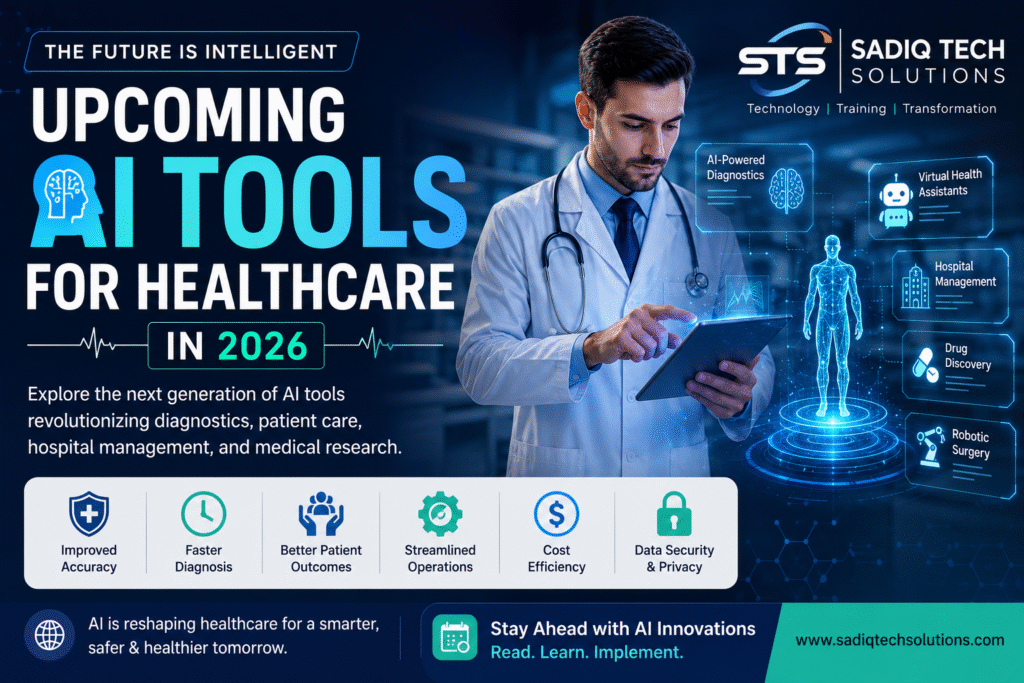
What Are AI Tools for Healthcare?
AI tools for healthcare are software applications and intelligent systems that use artificial intelligence, machine learning, natural language processing (NLP), and computer vision to assist healthcare professionals in diagnosing diseases, managing patient records, automating workflows, and improving treatment decisions.
These tools analyze large amounts of medical information within seconds, allowing healthcare providers to make faster and more informed decisions.
Common healthcare AI applications include:
- Disease diagnosis
- Medical image analysis
- Virtual health assistants
- Clinical documentation
- Drug research
- Patient monitoring
- Predictive healthcare analytics
- Hospital workflow automation
Why AI Is Transforming Healthcare in 2026
Healthcare systems are facing increasing patient demand, workforce shortages, and rising operational costs. AI is helping address these challenges by improving efficiency and supporting healthcare professionals with intelligent decision-making.
The demand for AI tools for healthcare continues to grow because they can:
- Reduce administrative workload
- Improve diagnostic accuracy
- Detect diseases earlier
- Enhance patient engagement
- Minimize medical errors
- Support personalized treatment plans
- Optimize hospital resources
As AI technology becomes more accessible, hospitals and clinics of all sizes are beginning to adopt these solutions.
Benefits of AI Tools for Healthcare
1. Faster Diagnosis
AI algorithms can analyze medical scans, pathology reports, and laboratory results within minutes, helping doctors identify diseases earlier than traditional methods.
2. Improved Accuracy
Machine learning models reduce diagnostic errors by recognizing patterns across millions of medical records and images.
3. Better Patient Care
AI supports personalized treatment recommendations based on patient history, genetics, lifestyle, and current health conditions.
4. Reduced Administrative Burden
Healthcare professionals spend significant time on documentation. AI automates appointment scheduling, billing, medical transcription, and record management.
5. Cost Savings
Hospitals using AI tools for healthcare can improve operational efficiency while reducing unnecessary testing and administrative expenses.
Top Upcoming AI Tools for Healthcare in 2026
1. Microsoft Dragon Copilot
Microsoft Dragon Copilot helps doctors automate clinical documentation using advanced speech recognition and AI-assisted note generation.
Key Features
- Medical transcription
- Voice-based documentation
- Clinical summaries
- Electronic Health Record (EHR) integration
2. Google MedLM
Google MedLM is designed specifically for healthcare organizations to assist with medical research, patient communication, and clinical workflows.
Features
- Medical question answering
- Clinical documentation
- Healthcare chatbot support
- Medical knowledge retrieval
3. NVIDIA Clara
NVIDIA Clara accelerates AI applications for medical imaging and life sciences.
Features
- Medical image analysis
- AI-assisted diagnostics
- Genomics research
- Drug discovery support
4. Aidoc
Aidoc uses artificial intelligence to prioritize urgent medical imaging cases for radiologists.
Best For
- CT scans
- MRI analysis
- Emergency departments
- Stroke detection
5. PathAI
PathAI assists pathologists by analyzing digital pathology slides with AI.
Benefits
- Faster cancer detection
- Improved diagnostic consistency
- Reduced workload
- Higher accuracy
6. Tempus AI
Tempus combines AI with precision medicine to help doctors choose personalized treatment plans.
Applications
- Oncology
- Cardiology
- Genomics
- Clinical research
7. Viz.ai
Viz.ai supports neurologists by rapidly identifying stroke patients from medical scans.
Features
- Stroke detection
- Emergency alerts
- Care coordination
- Faster treatment decisions
8. Butterfly iQ
Butterfly iQ combines portable ultrasound devices with AI guidance, making medical imaging more accessible in hospitals and remote locations.
9. Suki AI Assistant
Suki is an AI-powered assistant that simplifies clinical documentation and reduces physician burnout.
Features
- Voice commands
- Medical documentation
- EHR integration
- Workflow automation
10. Babylon AI
Babylon provides AI-powered symptom checking and virtual healthcare consultations, improving patient access to medical guidance.
AI in Diagnostics and Medical Imaging
Medical imaging remains one of the most impactful applications of AI tools for healthcare. AI systems can analyze X-rays, MRIs, CT scans, and ultrasound images with remarkable speed and accuracy.
Benefits include:
- Early cancer detection
- Improved fracture identification
- Faster emergency diagnosis
- Reduced radiologist workload
- Enhanced image quality
These capabilities help healthcare professionals make more confident and timely clinical decisions.
AI for Personalized Medicine
Personalized medicine tailors treatments to an individual’s unique genetic makeup, medical history, and lifestyle. AI analyzes complex datasets to recommend therapies that are more likely to be effective for specific patients.
Potential applications include:
- Cancer treatment planning
- Chronic disease management
- Genetic risk assessment
- Medication optimization
- Predictive health monitoring
By supporting precision medicine, AI tools for healthcare can improve treatment outcomes while minimizing unnecessary interventions.
AI in Hospital Management
Beyond patient care, AI is transforming hospital operations by automating routine administrative tasks and improving resource utilization.
Examples include:
- Intelligent appointment scheduling
- Bed occupancy forecasting
- Inventory management
- Staff scheduling
- Billing automation
- Patient flow optimization
These solutions reduce operational costs and allow healthcare staff to focus more on patient care.
AI for Telemedicine
Telemedicine has become an essential part of modern healthcare, and AI is making virtual care more efficient.
AI-powered telemedicine solutions offer:
- Virtual symptom assessment
- Automated appointment triage
- AI chatbots for patient support
- Remote patient monitoring
- Real-time language translation
- Clinical documentation assistance
These innovations improve access to healthcare, especially for patients in rural or underserved areas.
AI in Drug Discovery
Developing new medicines traditionally takes years and requires significant investment. AI accelerates this process by analyzing biological data, predicting drug interactions, and identifying promising compounds.
Advantages include:
- Faster research timelines
- Lower development costs
- Improved target identification
- Better clinical trial design
- Increased success rates
Pharmaceutical companies are increasingly adopting AI tools for healthcare to bring life-saving treatments to market more efficiently.
AI in Robotic Surgery
Robotic-assisted surgery continues to advance with AI-powered capabilities that enhance precision and decision-making.
Key benefits include:
- Greater surgical accuracy
- Smaller incisions
- Reduced blood loss
- Faster patient recovery
- Lower risk of complications
AI also supports surgeons by providing real-time guidance during complex procedures.
Challenges and Ethical Considerations
WhileAI tools for healthcare offer tremendous potential, responsible implementation is essential.
Important challenges include:
- Protecting patient privacy
- Ensuring data security
- Preventing algorithmic bias
- Maintaining transparency in AI recommendations
- Meeting healthcare regulations
- Providing adequate clinician training
Healthcare organizations must combine AI innovation with strong ethical and regulatory practices to build trust and ensure patient safety.
Future Trends in AI Healthcare
Looking ahead, several developments are expected to shape healthcare in the coming years:
- AI-powered digital twins for personalized treatment simulation
- Advanced predictive analytics for disease prevention
- Wearable devices with continuous AI health monitoring
- Real-time clinical decision support
- Autonomous hospital logistics
- AI-assisted mental health services
- Generative AI for medical education and documentation
These innovations will further strengthen the role of AI in delivering proactive, efficient, and patient-centered healthcare.
Frequently Asked Questions (FAQs)
What are AI tools for healthcare?
AI tools for healthcare are intelligent software solutions that assist with diagnostics, treatment planning, hospital management, patient communication, medical imaging, and administrative automation.
How do AI tools improve patient care?
They help clinicians diagnose diseases faster, personalize treatments, automate repetitive tasks, and support informed clinical decisions, leading to better patient outcomes.
Can AI replace doctors?
No. AI is designed to support healthcare professionals, not replace them. Final medical decisions should always be made by qualified clinicians.
Which healthcare sectors benefit the most from AI?
Radiology, pathology, cardiology, oncology, telemedicine, hospital administration, and pharmaceutical research are among the sectors experiencing significant benefits.
Are AI tools for healthcare secure?
Leading healthcare AI platforms follow strict security and privacy standards. However, organizations must implement proper cybersecurity measures and comply with healthcare regulations.
What is the future of AI in healthcare?
The future includes more personalized medicine, predictive analytics, AI-assisted surgery, smarter diagnostics, remote monitoring, and broader integration into everyday clinical workflows.
Conclusion
The future of healthcare is increasingly driven by intelligent technology, and AI tools for healthcare are at the center of this transformation. From improving diagnostic accuracy and streamlining hospital operations to enabling personalized treatments and accelerating drug discovery, AI is helping healthcare providers deliver higher-quality care while addressing growing operational challenges.
As hospitals, clinics, and research organizations continue to adopt these innovative solutions, the healthcare industry will become more efficient, data-driven, and patient-focused. While ethical considerations, data privacy, and regulatory compliance remain essential, the opportunities created by AI far outweigh the challenges when implemented responsibly.
Whether you are a healthcare professional, administrator, or technology enthusiast, staying informed about the latest AI tools for healthcare will help you prepare for a future where artificial intelligence plays an increasingly important role in improving patient outcomes and advancing medical innovation.
Ready to Start Your IT Career Journey?
Enroll for IT Career Courses Coding & Non-coding & Internship Program Today
→ https://sadiqtechsolutions.com/
For IT Career Courses Coding & Non-coding & e-Books this is the best site
→ https://topitcourses.com/
If you need IT Resume Templates for Free then Download Free Resumes here
→ https://topitcourses.com/free-resumes-download/
Read More Related Posts
How to Become a Generative AI Expert and Get a Job in 2026
→ https://sadiqtechsolutions.com/how-to-become-generative-ai-expert/
Edge AI vs Cloud AI: Which Should Your Business Use in 2026?
→ https://topitcourses.com/edge-ai-vs-cloud-ai-2026/
AI Impact on IT Jobs
→https://sadiqtechsolutions.com/ai-impact-on-it-jobs/
AI Automation Engineer Skills Required & Roadmap
→ https://sadiqtechsolutions.com/ai-automation-engineer-skills/
What is a Sailpoint Developer?
→https://topitcourses.com/what-is-sailpoint-developer-complete-guide/
Java Full Stack Developer Career Guide 2026
→ https://sadiqtechsolutions.com/java-full-stack-developer-career-guide-2026-salary-skills/
How to become a Prompt Engineer in 2026
→ https://sadiqtechsolutions.com/prompt-engineering-in-2026-skills-career-guide/
How to Get Your First IT Job With No Experience: A Practical Guide
→ https://sadiqtechsolutions.com/first-it-job-with-no-experience/
Data Analyst vs Data Scientist: Key Differences Explained
→ https://topitcourses.com/data-analyst-vs-data-scientist-key-differences/
Thankyou