
How Businesses Are Using Generative AI to Boost Productivity and Growth (2026 Guide)
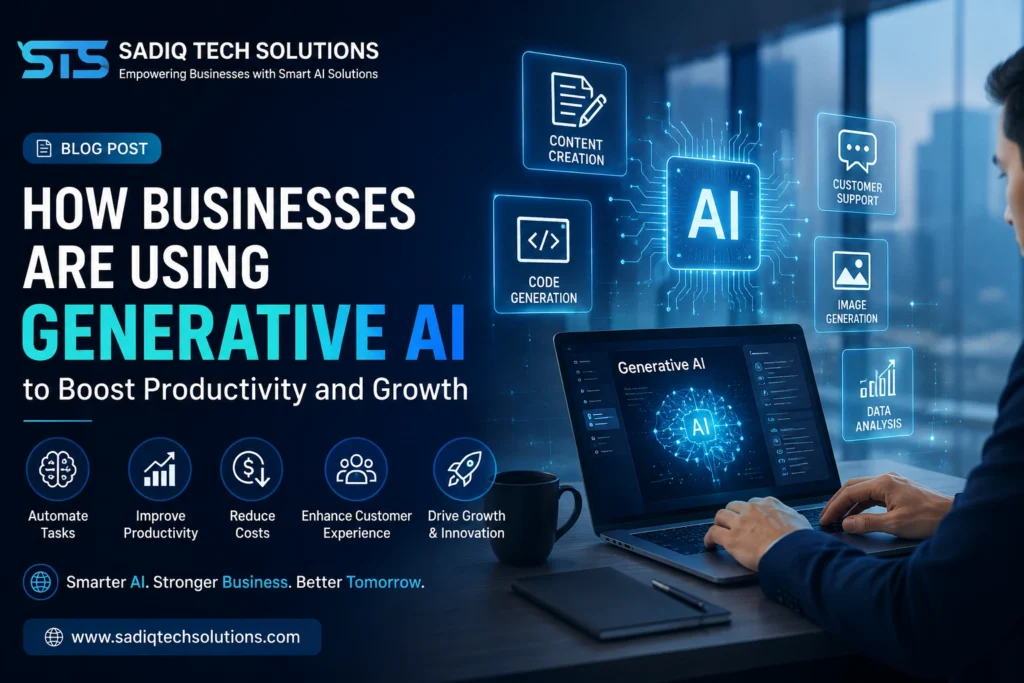
Generative AI has become one of the most revolutionary technologies in today’s digital world. Businesses of all sizes—from startups to multinational corporations are using Generative AI to automate repetitive tasks, improve customer experiences, accelerate innovation, and increase overall productivity.
Unlike traditional AI systems that primarily analyze data, This can create original content such as text, images, videos, code, presentations, marketing campaigns, and even business strategies. This capability enables organizations to save valuable time while allowing employees to focus on higher-value work.
In this comprehensive guide, you’ll discover how AI is transforming businesses, its key benefits, practical use cases, implementation strategies, challenges, and future trends.
What Is Generative AI?
Generative AI refers to artificial intelligence models capable of creating new content based on user prompts and existing data. These AI models learn patterns from massive datasets and generate human-like responses, making them valuable across multiple industries.
Examples of Generative AI include:
- ChatGPT
- Google Gemini
- Microsoft Copilot
- Claude AI
- Midjourney
- DALL·E
- Adobe Firefly
Today, AI is no longer limited to technology companies. Healthcare, finance, education, manufacturing, retail, marketing, and customer support are all adopting AI-powered solutions.
Why Businesses Are Investing in Generative AI
Organizations are adopting Generative AI because it delivers measurable improvements across business operations.
Some major reasons include:
- Increased employee productivity
- Faster decision-making
- Reduced operational costs
- Better customer engagement
- Improved creativity
- Enhanced workflow automation
- Higher revenue opportunities
- Competitive advantage
Businesses that successfully integrate AI often experience significant improvements in efficiency while maintaining high-quality outputs.
Top Ways Businesses Are Using Generative AI
1. Content Creation
Content marketing is one of the biggest applications of Generative AI.
Businesses use AI to generate:
- Blog posts
- Product descriptions
- Website copy
- Landing pages
- Email campaigns
- Social media captions
- Video scripts
- Marketing headlines
Instead of spending hours creating content manually, teams can produce high-quality drafts in minutes.
2. Customer Support Automation
Many organizations now integrate Generative AI chatbots into their websites.
AI-powered assistants can:
- Answer FAQs
- Resolve customer issues
- Recommend products
- Handle appointment scheduling
- Provide 24/7 support
This improves customer satisfaction while reducing support costs.
3. Software Development
Developers use Generative AI coding assistants to:
- Generate code
- Debug programs
- Explain complex code
- Write documentation
- Create test cases
- Optimize performance
Popular coding assistants include GitHub Copilot, ChatGPT, Amazon CodeWhisperer, and Cursor AI.
4. Marketing Campaigns
Marketing teams leverage AI to:
- Create advertisements
- Generate SEO content
- Produce campaign ideas
- Personalize customer messaging
- Design creatives
- Analyze audience behavior
AI helps marketers launch campaigns faster while improving conversion rates.
5. Sales Enablement
Sales professionals use Generative AI for:
- Personalized emails
- Sales proposals
- Meeting summaries
- CRM updates
- Follow-up messages
- Lead qualification
This allows sales teams to spend more time building customer relationships.
6. Human Resources
HR departments benefit from AI by automating:
- Job descriptions
- Resume screening
- Interview questions
- Employee onboarding
- Training materials
- Performance reviews
Recruitment becomes faster and more efficient.
7. Financial Operations
Finance teams use Generative AI for:
- Report generation
- Budget analysis
- Forecasting
- Invoice processing
- Financial summaries
- Risk assessment
Automation reduces manual errors while improving reporting accuracy.
8. Data Analysis
Organizations generate massive amounts of data every day.
Generative AI can:
- Summarize reports
- Identify trends
- Generate insights
- Visualize data
- Explain analytics
- Recommend business decisions
Executives can make informed decisions much faster.
9. Product Design
Companies use Generative AI to:
- Brainstorm product ideas
- Create prototypes
- Generate UI designs
- Produce product images
- Improve customer experiences
Design cycles become significantly shorter.
10. Employee Training
Businesses create personalized learning experiences using Generative AI.
AI can generate:
- Interactive lessons
- Learning paths
- Quizzes
- Documentation
- Video scripts
- Knowledge bases
Employees learn faster while organizations reduce training costs.
Benefits of Generative AI for Businesses
Increased Productivity
Employees complete repetitive tasks much faster using Generative AI, allowing them to focus on strategic work.
Cost Savings
Automation reduces labor-intensive processes, leading to significant operational savings.
Better Customer Experience
AI-powered personalization helps businesses deliver faster, more relevant customer interactions.
Faster Innovation
Teams can brainstorm ideas, create prototypes, and launch products more quickly with Generative AI.
Improved Decision Making
AI-generated insights help leaders make data-driven decisions confidently.
Higher Employee Satisfaction
Employees spend less time on repetitive work and more time solving meaningful business challenges.
Industries Benefiting from Generative AI
Healthcare
Hospitals use Generative AI for:
- Medical documentation
- Clinical summaries
- Drug research assistance
- Patient communication
Education
Educational institutions apply Generative AI to:
- Create study materials
- Generate quizzes
- Personalize learning
- Assist educators
Retail
Retail companies leverage Generative AI for:
- Product recommendations
- Inventory insights
- Personalized shopping experiences
- Customer support
Manufacturing
Manufacturers use Generative AI for:
- Process optimization
- Predictive maintenance
- Technical documentation
- Supply chain planning
Banking
Banks use Generative AI to improve:
- Fraud detection support
- Customer service
- Financial reporting
- Loan documentation
Challenges of Implementing Generative AI
Despite its advantages, Generative AI presents several challenges.
Data Privacy
Businesses must protect confidential customer and organizational information when using AI tools.
Accuracy
AI-generated responses may occasionally include incorrect or misleading information. Human review remains essential.
Ethical Concerns
Organizations should establish responsible AI policies to reduce bias and ensure transparency.
Employee Training
Successful adoption requires training employees to use Generative AI effectively.
Regulatory Compliance
Companies must comply with data protection regulations and industry-specific standards.
Best Practices for Using Generative AI
To maximize the value of Generative AI, businesses should:
- Define clear business objectives.
- Start with small pilot projects.
- Train employees on AI tools.
- Protect sensitive business data.
- Review AI-generated outputs.
- Measure productivity improvements.
- Continuously optimize workflows.
- Stay updated with new AI technologies.
Popular Generative AI Tools for Businesses
Some widely used Generative AI platforms include:
| Tool | Primary Use |
|---|---|
| ChatGPT | Content creation, coding, research |
| Google Gemini | Productivity, writing, analytics |
| Microsoft Copilot | Office automation |
| Claude AI | Writing and document analysis |
| GitHub Copilot | Software development |
| Midjourney | AI image generation |
| Adobe Firefly | Graphic design |
| Canva AI | Marketing design |
| Notion AI | Documentation |
| Jasper AI | Marketing content |
The Future of Generative AI in Business
The future of Generative AI is incredibly promising.
Businesses will increasingly use AI to:
- Automate end-to-end workflows
- Build intelligent virtual assistants
- Improve cybersecurity
- Create personalized customer experiences
- Accelerate software development
- Enhance business intelligence
- Support multilingual communication
- Improve operational efficiency
Organizations that invest in AI skills and responsible implementation today will be better positioned for long-term growth and innovation.
How Small Businesses Can Start with Generative AI
Small businesses do not need a large budget to benefit from Generative AI. They can begin by identifying repetitive tasks that consume time, such as writing emails, creating social media posts, responding to customer inquiries, or preparing reports. Many AI tools offer free or affordable plans, making it easy to experiment before scaling adoption.
A simple implementation roadmap includes:
- Identify one repetitive workflow.
- Choose a trusted AI tool.
- Train employees on prompt writing.
- Measure time saved and quality improvements.
- Expand AI usage to other departments.
By starting small and measuring results, even local businesses can improve efficiency and compete more effectively.
Real-World Examples of Generative AI in Business
The adoption of AI is no longer limited to technology companies. Organizations across industries are integrating AI into their daily operations to streamline workflows, improve customer experiences, and increase profitability. Below are some real-world examples of how businesses are successfully using Generative AI.
E-commerce
Online retailers use Generative AI to create personalized shopping experiences. AI analyzes customer behavior, purchase history, and browsing patterns to recommend products that match individual preferences. It can also generate compelling product descriptions, promotional emails, and seasonal marketing campaigns in minutes.
For example, an online clothing store can use AI to automatically write unique descriptions for thousands of products while suggesting outfit combinations for customers. This not only saves time but also improves search engine rankings and conversion rates.
Healthcare
Healthcare organizations use Generative AI to reduce administrative workloads and improve patient care. Doctors and nurses spend significant time creating clinical notes, medical reports, and discharge summaries. AI automates much of this documentation, allowing healthcare professionals to focus more on patients.
Additionally, pharmaceutical companies use AI to accelerate drug discovery by analyzing research papers, generating hypotheses, and identifying potential drug candidates much faster than traditional methods.
Banking and Finance
Financial institutions are leveraging AI to improve customer service, generate financial reports, summarize investment portfolios, and detect unusual transaction patterns. AI-powered virtual assistants help customers with account inquiries, loan applications, and investment guidance around the clock.
Banks also use AI to draft personalized financial recommendations based on a customer’s spending habits and financial goals, improving customer satisfaction and engagement.
Manufacturing
Manufacturing companies use AI to optimize production schedules, generate maintenance documentation, and predict equipment failures. AI can analyze machine data and suggest preventive maintenance before breakdowns occur, reducing downtime and operational costs.
Engineers also use AI to create product designs, simulate manufacturing processes, and identify ways to improve production efficiency.
Tips for Successfully Implementing Generative AI
Adopting AI requires more than simply subscribing to an AI tool. Businesses should develop a clear implementation strategy to maximize return on investment while minimizing potential risks.
Here are some practical tips:
Start with High-Impact Use Cases
Instead of trying to automate every department at once, begin with tasks that consume the most time, such as customer support, content creation, or internal documentation. Early successes help build confidence and encourage wider adoption across the organization.
Train Employees
The quality of AI-generated outputs depends largely on how users interact with the system. Employees should be trained in prompt engineering, fact-checking, and responsible AI usage. Well-trained teams can produce significantly better results.
Establish AI Governance
Organizations should create policies defining how Generative AI can be used, what data can be shared, and who is responsible for reviewing AI-generated content. Clear governance helps maintain security, compliance, and consistency.
Monitor Performance
Businesses should continuously measure AI performance using key metrics such as time saved, customer satisfaction, operational costs, content production speed, and employee productivity. Regular evaluation ensures AI initiatives continue delivering value.
Keep Humans in the Loop
Although AI is highly capable, it should complement—not replace—human expertise. Human oversight is essential for reviewing important decisions, ensuring accuracy, and maintaining brand.
Final Thoughts
This is reshaping the future of business by enabling organizations to work smarter, innovate faster, and deliver greater value to customers. Whether it’s automating repetitive tasks, creating personalized marketing campaigns, improving customer support, assisting software developers, or enhancing business intelligence, Generative AI is becoming an indispensable part of modern business operations.
As AI technology continues to evolve, businesses that embrace responsible adoption, invest in employee training, and integrate AI strategically will gain a significant competitive advantage. Rather than replacing human talent, AI empowers employees by reducing manual work and allowing them to focus on creativity, strategic thinking, and innovation.
The future belongs to organizations that combine human expertise with the power of Generative AI. By starting with practical use cases, maintaining strong governance, and continuously optimizing AI-driven processes, businesses can unlock higher productivity, sustainable growth, and long-term success in the rapidly evolving digital economy.
Frequently Asked Questions (FAQs)
Is Generative AI only for large companies?
No. Businesses of all sizes can use AI for marketing, customer service, content creation, and automation.
Can Generative AI replace employees?
Generative AI is designed to assist employees by automating repetitive tasks. Human creativity, critical thinking, and decision-making remain essential.
Which industries benefit the most from Generative AI?
Healthcare, education, retail, finance, manufacturing, software development, marketing, and customer service are among the leading adopters.
Is Generative AI secure?
It can be secure when organizations follow data protection policies, choose reputable AI providers, and avoid sharing sensitive information without proper safeguards.
How can businesses measure the success of Generative AI?
Track metrics such as time saved, operational costs, employee productivity, customer satisfaction, content production speed, and revenue growth.
Conclusion
Generative AI is transforming the way businesses operate by improving productivity, reducing costs, enhancing customer experiences, and accelerating innovation. From creating marketing content and automating customer support to assisting software developers and analyzing business data, AI is becoming an essential tool for organizations across industries.
However, successful adoption requires thoughtful planning, employee training, strong governance, and responsible AI practices. Businesses that embrace Generative AI while maintaining human oversight will be better equipped to adapt to changing market demands and unlock new growth opportunities.
Whether you’re a startup, a small business, or a large enterprise, now is the ideal time to explore how Generative AI can streamline operations, empower your workforce, and drive sustainable business success in 2026 and beyond.
Ready to Start Your IT Career Journey?
Enroll for IT Career Courses Coding & Non-coding & Internship Program Today
→ https://sadiqtechsolutions.com/
Download Free All IT Career Courses Coding & Non-coding & e-Books Here
→ https://topitcourses.com/
If you need IT Resume Templates for Free then Download Free Resumes here
→ https://topitcourses.com/free-resumes-download/
Read More Related Posts
How to Become a Generative AI Expert and Get a Job in 2026
→ https://sadiqtechsolutions.com/how-to-become-generative-ai-expert/
Edge AI vs Cloud AI: Which Should Your Business Use in 2026?
→ https://topitcourses.com/edge-ai-vs-cloud-ai-2026/
AI Impact on IT Jobs
→https://sadiqtechsolutions.com/ai-impact-on-it-jobs/
AI Automation Engineer Skills Required & Roadmap
→ https://sadiqtechsolutions.com/ai-automation-engineer-skills/
What is a Sailpoint Developer?
→https://topitcourses.com/what-is-sailpoint-developer-complete-guide/
Java Full Stack Developer Career Guide 2026
→ https://sadiqtechsolutions.com/java-full-stack-developer-career-guide-2026-salary-skills/
How to become a Prompt Engineer in 2026
→ https://sadiqtechsolutions.com/prompt-engineering-in-2026-skills-career-guide/
Best Python Institute in Anantapur
→ https://sadiqtechsolutions.com/best-python-institute-in-anantapur/
Best Video Editing Course in Anantapur
→ https://sadiqtechsolutions.com/best-video-editing-course-in-anantapur/
How to Get Your First IT Job With No Experience: A Practical Guide
→ https://sadiqtechsolutions.com/first-it-job-with-no-experience/
Data Analyst vs Data Scientist: Key Differences Explained
→ https://topitcourses.com/data-analyst-vs-data-scientist-key-differences/
Thankyou